Milliman’s December 2025 Multiemployer Pension Funding Study reports on the estimated funded status of all U.S. multiemployer defined benefit (DB) plans as of December 31, 2025.
Key findings
- The aggregate funded percentage for all multiemployer plans was 103% as of December 31, 2025, up from 97% at the end of 2024.
- The funded percentage has surpassed 100% and sits at its highest level in our nearly 20-year study period. Investment returns, contributions in excess of benefit costs, and Special Financial Assistance (SFA) have all played a part in the improvement.
- Our assumed asset portfolio earned approximately 13.9% for 2025.1
- As of December 31, 2025, 146 plans2 have received nearly $75 billion in SFA under the American Rescue Plan Act of 2021 (ARP), which has added 9% to the aggregate funded percentage since the SFA program’s inception.
Current multiemployer pension funded percentage
Figure 1 shows that the overall funding for all plans improved by about $51 billion during 2025 to a surplus of approximately $28 billion. The aggregate funded percentage increased from 97% to 103%.
Figure 1: Aggregate funded percentage (in $ billions)
| 12/31/2024 | 12/31/2025 | CHANGE | |
|---|---|---|---|
| Accrued benefit liability | $818 | $842 | $24 |
| Market value of assets | (795) | (870) | (75) |
| Shortfall/(Surplus) | $23 | $(28) | $(51) |
| Funded percentage | 97% | 103% | 6% |
Based on plans with complete IRS Form 5500 filings. Includes 1,193 plans as of December 31, 2024, and 1,180 plans as of December 31, 2025.
The amounts in Figure 1 reflect the $75 billion in SFA granted to 146 plans that received the funds by December 31, 2025, including $5 billion paid during 2025. Without the SFA program, the aggregate funded percentage would be approximately 94%.
The liabilities in Figure 1 are projected using discount rates equal to each plan’s actuarial assumed return on assets. Assumed returns generally fall between 6.0% and 8.0%, with a weighted average interest rate assumption for all plans of about 6.8%, unchanged from a year ago.
The assets in Figure 1 are based on the most recently reported market value of assets for each plan, projected forward, assuming asset returns observed for a diversified portfolio typical for a U.S. multiemployer pension plan. Our simplified portfolio earned about 13.9% in 2025.
Historical multiemployer pension funded percentage
Figure 2 provides a historical perspective on the aggregate market value funded percentage of all multiemployer plans since the end of 2007.
Figure 2: Aggregate historical funded percentage market value basis
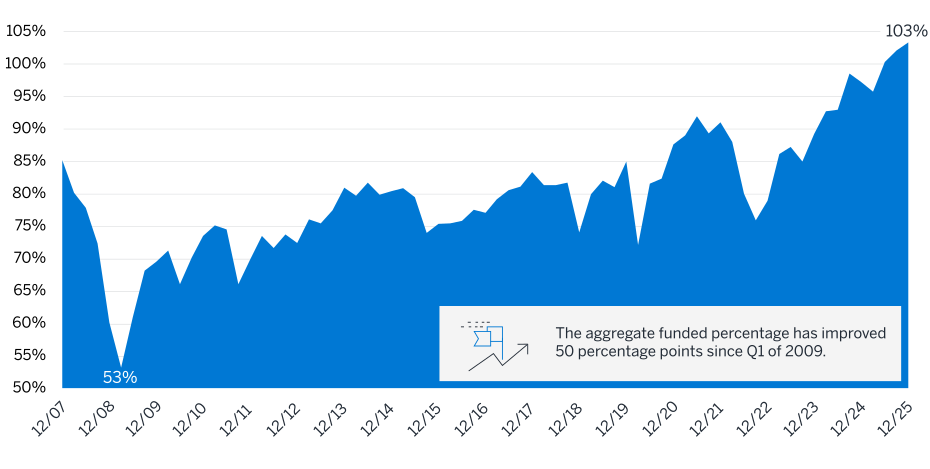
The substantial rise in the aggregate funded percentage in 2025 was largely attributable to the strong asset gains during the year. SFA totaling $5 billion (about 0.6% of all assets) also contributed to the improvement. The aggregate funded percentage at the end of 2025 reached its highest point over the study period, marking an improvement of 50 percentage points since the low point in the first quarter of 2009. The sharp peaks and valleys of the graph underscore the significance of investment returns on the funded status of these plans.
While investment performance has been a major factor, we have also observed that, in aggregate, annual employer contributions have consistently exceeded the combined costs of benefit accruals and administrative expenses. This trend likely reflects proactive measures by many plans to strengthen their funded status through increased contributions and benefit adjustments, resulting in annual contributions that surpass immediate funding needs. For instance, over the past decade, total contributions amounted to approximately $331 billion, compared to about $212 billion in total benefit accrual and administrative costs.
Figure 3 shows the distribution of funded percentages for all plans in the study as of December 31, 2025.
Figure 3: Market value funded percentage (%) as of 12/31/2025
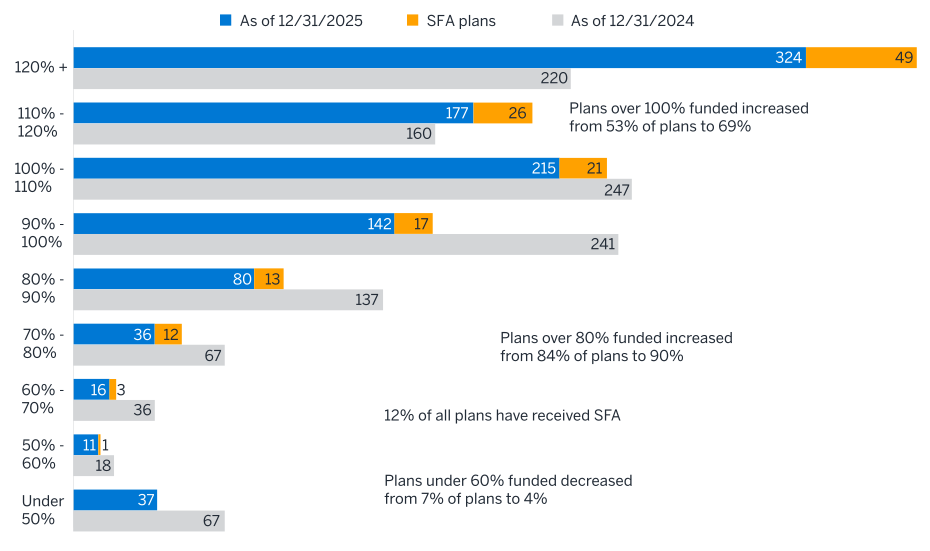
Over two-thirds of all plans, 69% (812 of 1,180), are 100% funded or more, and 90% (1,064) are 80% funded or better. Except for SFA plans,3 these plans are likely in the green zone under the Pension Protection Act of 2006 (PPA). However, they still face significant risks.
Achieving a funded status above 100% is a desirable goal for many plans. When a plan reaches 100% funding, it means there are sufficient assets to meet all accrued liabilities as of today if assets earn their expected return each year in the future. However, since investment returns are not guaranteed, plans typically target funding levels above 100% to build a buffer that can help absorb the impact of future market downturns and ensure long-term sustainability.
At the other end, only 4% of plans (49) are below 60% funded and may be headed toward insolvency. Some of these might be eligible for SFA and may receive it in 2026 or 2027.
Figure 3 shows SFA plans with various funding levels, including 96 that are 100% funded or better. This may be due to 1) positive plan experience, 2) differences in the assumptions, methodologies, and timing used by each plan when applying for SFA, and 3) restored benefits and loan repayments included in SFA applications.
Historical funded percentage, multiemployer pensions, by zone status
Figure 4 shows the historical funded percentage of all multiemployer plans since the end of 2007 by the zone status reported on the latest Form 5500 used for the study. For example, the green line shows the historical funded percentages of plans reported in the green zone without regard to their previous zone statuses. The gray line corresponds to plans that have received SFA by December 31, 2025. The blue dotted line represents all plans combined.
Figure 4: Aggregate historical funded percentage by zone status and SFA
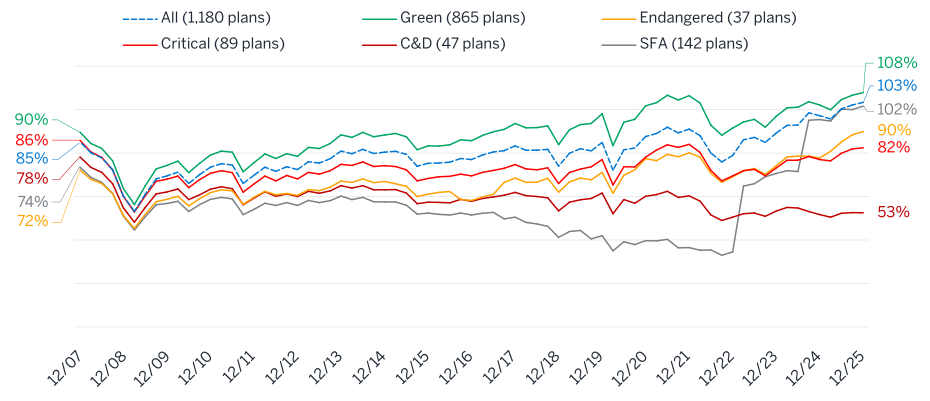
Most of the 146 plans that have received SFA were either on the brink of insolvency or not expected to recover in the near term. As expected, after receiving SFA, their funded statuses have improved substantially. We estimate that the aggregate funded percentage of these plans would have been about 32% without SFA.
The 902 plans in the yellow and green zones have, in the aggregate, largely recovered from the 2008 global financial crisis and continue to navigate the ups and downs of the market. In contrast, the 136 plans in critical and critical and declining (C&D) statuses continue to face significant challenges. Some of these plans may still be in the process of applying for SFA or awaiting approval of payment of SFA.
In addition to the factors discussed previously, multiemployer pension plans have been significantly impacted by changes in the discount rate used to measure plan liabilities.
Figure 5 shows a history of the average discount rate assumption4 for all plans in our study.
Figure 5: Average discount rate
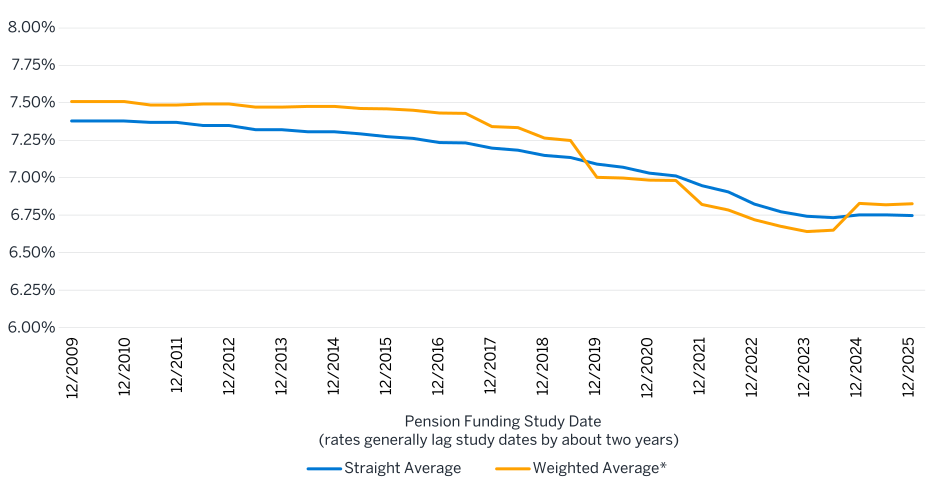
* The abrupt changes in the weighted average discount rate over the past several years are primarily due to changes in the discount rate for one large plan (Central States, Southeast & Southwest Areas Pension Plan).
The discount rate for each plan is typically set equal to the assumed return on plan assets. That assumption is based on the plan’s asset allocation and forward-looking capital market assumptions. Up until recently, the general declines in discount rates have increased multiemployer plan liabilities, all else being equal. However, in the last few years, the discount rate has flattened out.
Due to reporting delays (the latest information is as of the beginning of the 2024 plan year for most plans), we will not know what current discount rates are for a couple of years. It is difficult to predict how capital markets and asset allocations will change discount rates going forward.
SFA for multiemployer pensions is winding down
SFA has had a meaningful impact on the most financially stressed plans over the last few years. About $75 billion of the Pension Benefit Guaranty Corporation’s (PBGC’s) median estimate of $79 billion in SFA funds has been distributed. If the remaining estimated $4 billion of SFA were paid now, the aggregate funded status would increase to 104%. SFA payments to plans are expected to continue through 2026 and possibly into 2027.
The SFA program was initially interpreted by PBGC to apply only to ongoing plans that met the SFA eligibility requirements. However, the U.S. Court of Appeals for the Second Circuit ruled that “a plan terminated by mass withdrawal before 2020 is not per se ineligible to receive SFA.”5 This decision could significantly broaden SFA eligibility to multiemployer plans that terminated by mass withdrawal, potentially increasing total program outlays by an additional $6 billion.6 PBGC has since petitioned the Supreme Court to review this case. Ninety-two plans that terminated due to mass withdrawal prior to the 2020 plan year have submitted an initial application by the statutory SFA application deadline of December 31, 2025. Because terminated plans do not file actuarial information on IRS Form 5500, this study will continue to only report on ongoing plans.
What lies ahead for multiemployer pension plans?
While the improvement in funded position to its highest level is a notable achievement, significant risks remain, such as those related to economic volatility and growing plan maturity. Trustees and plan professionals should continue to monitor ongoing risks and understand the impact of any potential changes on their plans.
About this study
The results in this study were derived from publicly available IRS Form 5500 data filed through December 2025 for all multiemployer plans, numbering around 1,200 plans. Data for a limited number of plans that clearly were erroneous was modified to ensure the results were reasonable and a sufficiently complete representation of the multiemployer universe. Such adjustments were associated with an immaterial number of plans.
Liability amounts were based on unit credit accrued liabilities reported on Schedule MB and were adjusted to the relevant measurement dates using standard actuarial approximation techniques. For this purpose, each plan’s monthly cash flow, benefit cost, and actuarial assumptions were assumed to be constant throughout the year and in the future. Projections of asset values to the measurement date reflect the use of constant cash flows and monthly index returns for a simplified portfolio composed of 42% public equity, 7% private equity, 24% investment grade debt, 4% high-yield debt, 10% real assets, 2% cash and cash equivalents, and 11% other. This asset portfolio is based on the average asset mix reported on Form 5500 Schedule R for which complete data was available, weighted based on each plan’s reported market value of assets.
Changes to an individual plan's data or assumptions would likely not have a significant impact on the aggregate results or the conclusions in this study.
This study reports on funded percentages and levels based on one reasonable measure of funding for these plans, where liabilities are developed using each plan’s assumed return on assets as the discount rate. Other methods of measuring liabilities and funded statuses may produce different results.
Tim Connor is a principal and consulting actuary in the Little Falls, New Jersey, office of Milliman.
1 Individual plans’ returns may have been higher or lower based on their asset allocations, asset classes, and management styles. For more information about the asset portfolio used for this study, see the section “About this study.”
2 For this study, four of the 146 plans are of immaterial size and were excluded.
3 As required by ARP, plans that received SFA will remain in the red zone through the plan year ending in 2051 regardless of their funded percentage.
4 Figure 5 shows the straight average discount rate (which weights each plan equally and diminishes the impact any one plan has on the overall average) and the average discount rate weighted by liabilities.
5 Pension Benefit Guaranty Corporation. (January 27, 2026). Projections report – FY 2024. Retrieved February 6, 2026, from https://www.pbgc.gov/sites/default/files/documents/fy-2024-projections-report.pdf.
6 Novak, N. J. (June 16, 2025). Recent Court of Appeals ruling may cost taxpayers approximately $6 billion more in Special Financial Assistance than originally projected [Risk Advisory]. Pension Benefit Guaranty Corporation Office of Inspector General. Retrieved February 6, 2026, from https://www.oversight.gov/sites/default/files/documents/reports/2025-06/SR-2025-09.pdf.